

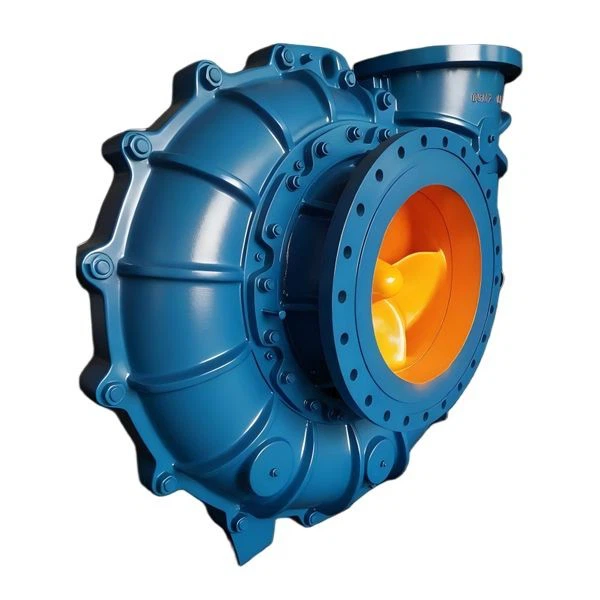
FGD Pump
Product Overview
The FGD Pump is a heavy-duty, horizontal cantilevered centrifugal slurry pump engineered specifically for wet flue gas desulfurization (FGD) systems. Built to withstand the dual-threat challenges of high abrasive crystal slurries (limestone and gypsum) and acidic chemical corrosion, this pump series delivers continuous hydraulic stability in power plants and industrial scrubber islands. It is optimized to eliminate unplanned downtime in demanding particulate-laden transport loops.


Working Conditions & Pumping Medium
Pumping Medium
Limestone slurry (pH 5-7), gypsum suspension (pH 4-6), chloride-laden scrubber effluent, and fly ash.
01
Solid Concentration
Up to 60% by weight (w/w).
02
Particle Size (d50)
Up to 1 mm (tailored hydraulic volutes prevent localized choking).
03
Operating Temperature
Up to 120°C (248°F).
04
PH Range
2.5 to 12 (acidic and highly alkaline environments).
05
Construction & Materials
Material selection is engineered directly against specific chemical assays and abrasion profiles of the slurry. Components are cast using certified metallurgical grades:
|
Component |
Standard Material Options |
Metallurgy / Characteristics |
|
Impeller & Volute Liner |
ASTM A532 Class III Type A (A49) |
High-chrome white iron (~27% Cr with controlled Mo), delivering a surface hardness >60 HRC to resist crystal wear. |
|
Alternative Wet End |
CD4MCu / Duplex Stainless Steel |
Ferritic-austenitic alloy offering high resistance to chloride stress corrosion cracking and pitting in low-pH scrubber zones. |
|
Heavy-Duty Shaft |
4140 Alloy Steel / 431 Stainless Steel |
High torsional modulus minimizes shaft deflection under extreme radial loads, protecting mechanical seals. |
|
Bearing Assembly |
Spherical & Cylindrical Roller Bearings |
Grease or oil-lubricated with multi-lip labyrinth seals to prevent moisture and particulate ingress in wet plant environments. |
Key Performance Features & Technologies
Optimized Wide-Passage Hydraulics: Reduced peripheral impeller velocities lower impact angles, directly mitigating cutting wear against hard limestone and gypsum particles.
Hydro-Dynamic Expeller Seal: Utilizes an auxiliary back-vane impeller that generates counter-pressure during operation, preventing slurry migration along the shaft and eliminating the need for gland flush water where site resources are restricted.
Optional Dual-Cartridge Mechanical Seal: For circuits requiring zero atmospheric leakage, the flush-optimized cartridge seal design ensures internal thermal dissipation and prevents solids buildup on seal faces.
External Impeller Clearance Adjustment: A heavy-duty adjusting bolt beneath the bearing housing allows maintenance teams to reset the front liner clearance without dismantling the entire wet end, sustaining high hydraulic efficiency over time.
Back-Pull-Out Assembly: Permits removal of the complete rotating element (bearing housing, shaft, and impeller) without disturbing suction/discharge piping or motor alignment.

Applications
Coal-Fired Power Generation
Absorber recirculation loops, limestone preparation systems, and gypsum hydrocyclone feed.
Metallurgical & Sinter Plant Scrubbers
Handling sulfur dioxide (SO2) scrubbing liquors and acidic wastewater.
Chemical Processing
Effluent treatment loops dealing with high-chloride and sulfate-rich industrial waste.
Pump Configuration & Selection
Accurate pump sizing ensures optimal wear life and energy efficiency. Provide your engineering team with the following parameters for sizing and performance curve matching:
Required Flow Rate (Q) and Total Dynamic Head (HD).
Slurry Specific Gravity and W/W Concentration (%).
Particle Hardness (Mohs scale) and d50 particle distribution.
Driver Specifications: Operating voltage, frequency, and motor enclosure standard (e.g., IP55, IEEE 841).
Manufacturing & Quality Control

Foundry & Metallurgy
Spectrographic chemical composition analysis is performed on every melt before pouring. Castings undergo ultrasonic (UT) and magnetic particle (MT) testing to eliminate internal shrinkage voids.

Precision CNC Machining
Volutes and bearing frames are processed on large CNC boring mills, holding critical concentricity tolerances within +/-0.02 mm to prevent premature bearing wear.

Dynamic Balancing
Impellers are dynamically balanced to ISO 1940 Grade G2.5 standards to eliminate vibration at running speeds.
Hydrostatic Pressure Testing
Every assembled pump casing is pressure-tested at 1.5 times maximum working pressure prior to coating and shipment.
Maintenance & Spare Parts Support
Dimensional Interchangeability
Wet-end components (impellers, throat bushes, frame plate liners) match standard heavy-duty industrial footprints, allowing direct drop-in replacement in existing installations.
Condition-Based Monitoring
Integrated inspection ports and replaceable wear rings allow accurate wear tracking without full teardown.
Documentation Package
Shipments include certified material test reports (CMTR per EN 10204 3.1), balancing protocols, and comprehensive installation and maintenance manuals.
Frequently Asked Questions
Shijiazhuang Ruite Pump Co., Ltd. is one of the most experienced FGD pump manufacturers and suppliers in China. Please rest assured to wholesale high quality FGD pump made in China here from our factory. For price consultation, contact us.
Desulfurization Slurry Pump, Horizontal Slurry Pump in Flue Gas Desulphurizatio, Vertical Slurry Pump in Flue Gas Desulphurization