

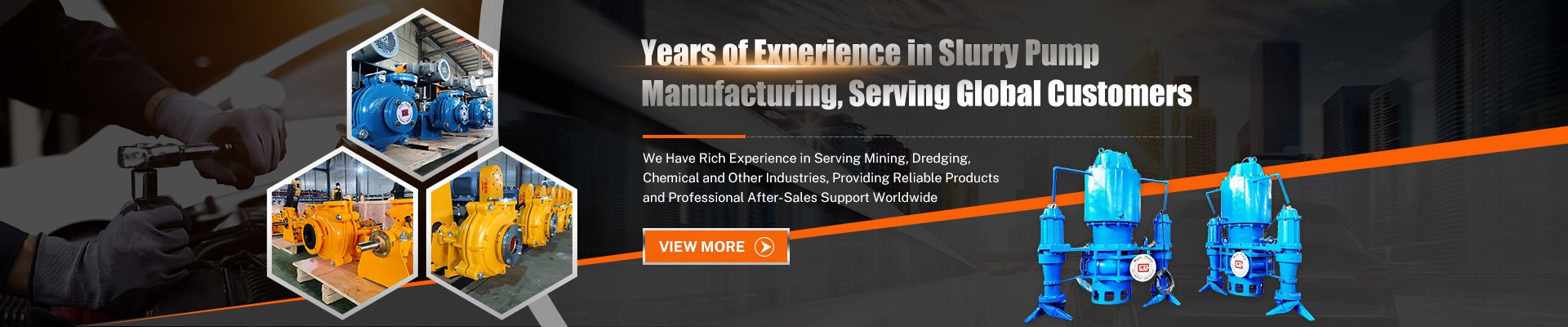
A slurry pump is a type of pump equipment specifically designed for conveying slurry containing solid particles, and its working principle is mainly based on the action of centrifugal force.
When the slurry pump is started, the motor drives the impeller to rotate at high speed. The blades on the impeller exert centrifugal force on the slurry, causing the solid particles and liquid in the slurry to be thrown towards the outer edge of the impeller. In this process, a low-pressure area forms in the central region of the impeller, and the inlet of the pump is connected to this low-pressure area. Due to the influence of external atmospheric pressure, the slurry is drawn into the pump and continuously accelerated and pressurized as the impeller rotates.When the slurry reaches the outer edge of the impeller, it acquires sufficient kinetic and pressure energy, and is then guided by the guide vane or volute in the pump body to the outlet of the pump, thus achieving continuous conveyance of the slurry. The design characteristics of the slurry pump enable it to handle slurry with high concentration, high viscosity, and media containing large solid particles.
Its impeller and pump body are usually made of wear-resistant materials to cope with the wear caused by solid particles in the slurry. At the same time, the sealing structure of the slurry pump is also specially designed to prevent slurry leakage and the entry of external impurities into the pump. In practical applications, slurry pumps are widely used in mining, metallurgy, coal, power, environmental protection, and other fields.For example, in the mining industry, slurry pumps are used to transport slurry, tailings, etc.; in the metallurgical industry, they are used to transport slag, waste residue, etc. during the smelting process.
These application scenarios require slurry pumps to have characteristics such as high efficiency, wear resistance, and corrosion resistance to ensure long-term stable operation and reduce maintenance costs. In addition, performance parameters of slurry pumps such as flow rate, head, power, etc. are also important factors to consider when selecting and using them. Different application scenarios have different performance requirements for slurry pumps, so reasonable selection and configuration need to be made according to the actual situation.


